


Choosing an inline speed skate frame starts with three questions: does it fit your boot, does it support the wheels you want to use, and is its length appropriate for your skating? Get those decisions right before comparing weight, materials, or price.
A long racing frame may suit an experienced skater, but it can be difficult for a smaller or developing skater to control. Equally, a frame with the correct wheel capacity may still have the wrong mounting system. This guide explains how to read the specifications and build a setup that works together.
The Three Measurements You Need to Understand
Frame length, wheel diameter, and mounting distance describe different parts of a skate. They are not interchangeable.
- Frame length: Usually the wheelbase, measured from the centre of the front axle to the centre of the rear axle. It is commonly listed in inches. Check the manufacturer's measurement convention when comparing frames.
- Wheel configuration: The number and diameter of the wheels, such as 4 x 90mm or 3 x 125mm. The frame must be designed for that arrangement.
- Mounting distance: The centre-to-centre spacing between the boot's mounting points. On a two-point system, these are the front and rear attachment points.
For example, a frame labelled 13.2 inches, 4 x 110mm, 195mm describes its length, wheel setup, and mounting spacing, respectively. The 195mm figure does not tell you the frame length or the boot size.
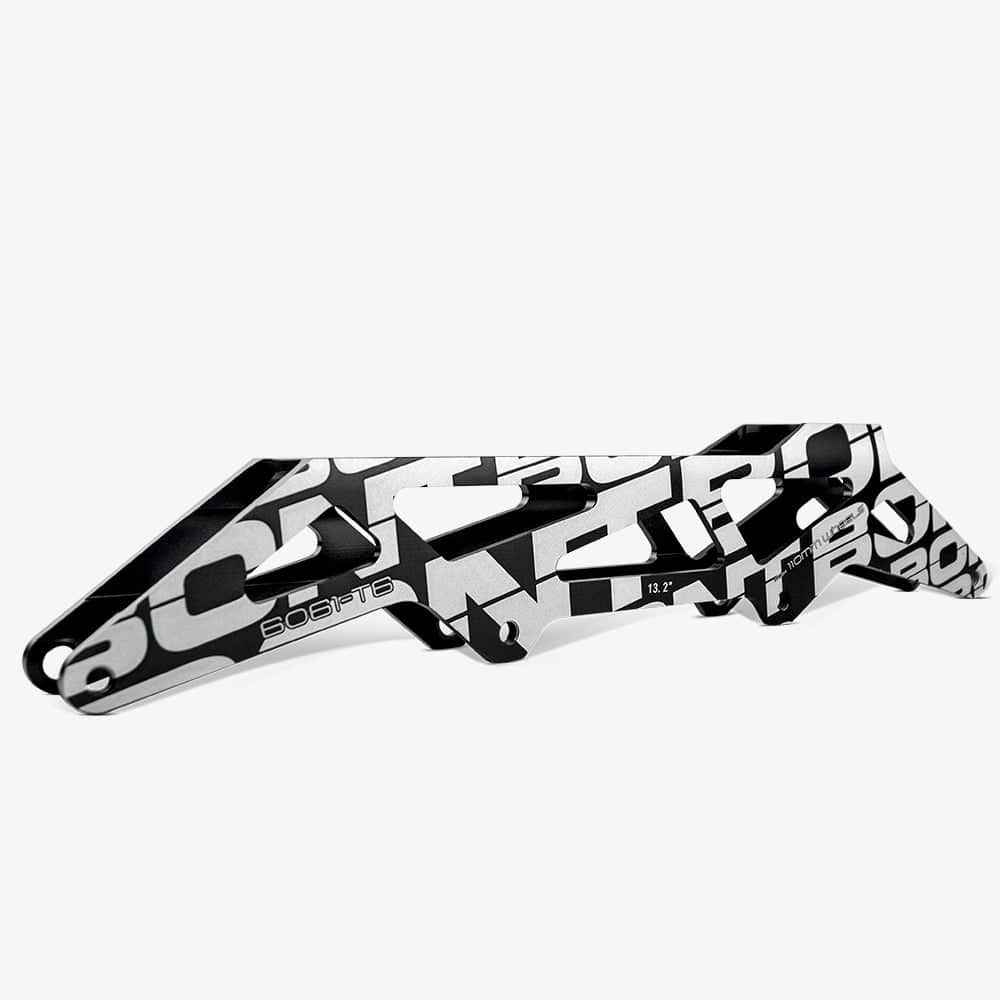
The 2PF Unity is offered in several lengths and wheel configurations. Check the specifications of the selected version.
How Frame Length Changes the Way Your Skates Feel
Shorter Frames
A shorter wheelbase generally makes changes of direction easier and keeps the front and rear wheels closer to the skater. That can help with learning crossovers and managing a setup under a smaller boot. However, short does not automatically mean beginner-friendly: a compact three-wheel frame with large wheels can still create a demanding, tall setup.
Longer Frames
A longer wheelbase generally feels more settled in straight-line skating, but it takes more space and technique to move the skates around each other. Extra length can become a disadvantage if you repeatedly clip wheels during crossovers or struggle to place the skate where you want it.
Length alone does not make a skate faster. The useful choice is a frame that lets you accelerate, corner, and maintain a controlled stride. Wheel size, ride height, frame flex, and the skater's technique all contribute to the result.
Choose Length for Your Feet, Experience, and Event
Start with a properly fitted boot. Buying an oversized boot to accommodate a particular frame compromises the foundation of the setup. There is also no single shoe-size formula that identifies the best frame for every skater.
For children and new speed skaters, prioritise manageable wheels and a frame that allows clean crossovers and balanced one-foot gliding. Bont's setup guide by experience level is a useful starting point for matching equipment to the skater.
If you already skate comfortably, use your current setup as a reference. Record its length, wheel size, and mounting details, then identify what you want to improve. Changing frame length and wheel diameter together makes it harder to tell which change helped.
For racing, discuss the choice with your coach and check the current requirements for your event and age group. A marathon setup and a junior track setup have different priorities. The largest wheel a frame accepts is a capacity limit, not an automatic recommendation.
Understand 150mm, 165mm, and 195mm Mounting
Bont offers two-point frames with different mounting options, including 150mm, 165mm, and 195mm. Some individual versions accommodate more than one spacing. Always read the selected size's specification rather than treating the range listed for the whole product family as universal compatibility.
For an existing boot, identify the model and size, then check its mounting specification. If measuring a two-point mount, measure between the centres of the front and rear attachment points, not between the outside edges of the mounting blocks.
Check the Exact Boot Size
The Eclipse boot illustrates why size-specific information matters. Its current size selector labels the 195mm, 200mm, 205mm, 210mm, and 215mm boot-size options with 165mm mounts, even though the product's general description refers to a 195mm mount. A boot-size label and a mounting measurement can both use millimetres while describing different things.
If the selected option and the general description leave any uncertainty, ask Bont to confirm the mounting for that exact boot before ordering a frame.
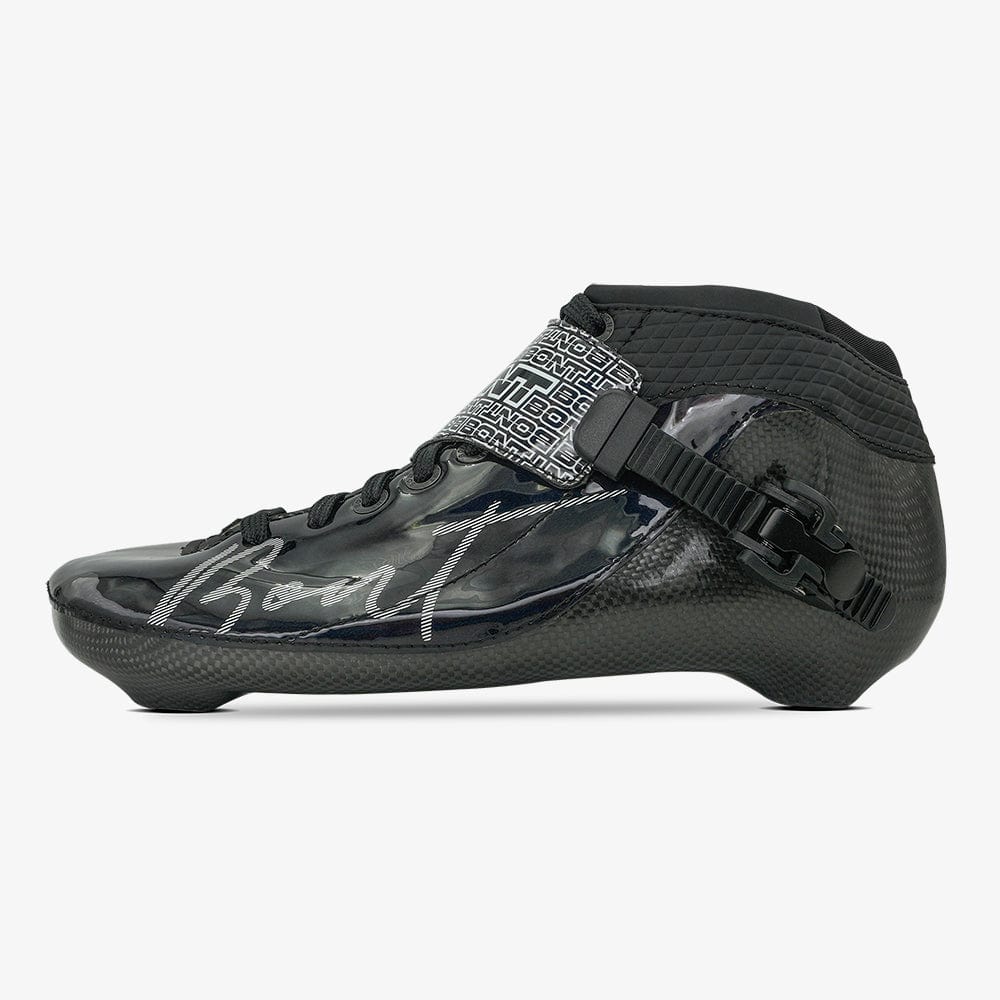
Choose the boot for fit, then confirm the mounting specification for its exact size.
Matching Spacing Is Only the First Check
The mounting system, contact surfaces, hardware, and available clearance must also work together. A matching distance does not make every boot and frame combination compatible. Check that the frame seats correctly against the boot and that the intended wheels clear the boot and mounting hardware.
Do not infer the number of mounting points from a product name. For example, the current 3PF 7050 Inline Frame listing specifies two-point 195mm mounting and states that it will not work on three-point boots.
Bont Frame Length and Mounting Examples
These examples show how the specifications fit together. They are configuration examples, not a recommendation to move up to larger wheels. Confirm the current product options before purchasing.
| Frame | Length | Wheel configuration | Mount spacing |
|---|---|---|---|
| 2PF 6061 | 9.6 inches | 4 x 80mm | 150mm or 165mm |
| 2PF 6061 | 10.25 inches | 4 x 84mm | 150mm or 165mm |
| 2PF 6061 | 11.25 inches | 4 x 90mm | 165mm or 195mm |
| 2PF 6061 | 12.0 inches | 4 x 100mm | 195mm |
| 2PF Unity | 11.25 inches | 4 x 90mm or 3 x 110mm | 165mm or 195mm |
| 2PF Unity | 11.8 inches | 3 x 125mm | 195mm |
| 2PF Unity | 13.2 inches | 4 x 110mm | 195mm |
Specifications: 2PF 6061 and 2PF Unity. The 9.6-inch and 10.25-inch 2PF 6061 versions are specifically listed with vertical mounts; confirm the mounting arrangement with your boot.
Three Wheels, Four Wheels, and Mixed Wheel Sizes
Wheel count does not determine frame length by itself. Compare the stated wheelbase, wheel diameter, and mounting details together. A three-wheel frame is not necessarily shorter than every four-wheel frame.
The 11.25-inch Unity provides a useful example: it is designed for either four 90mm wheels or three 110mm wheels. The frame length remains the same, while the wheel arrangement and ride height change. That flexibility is specific to the frame's design. Removing one wheel from a conventional four-wheel frame does not create an equivalent three-wheel setup.
Mixed-wheel, or hi-low, frames also require the specified combination and wheel positions. Follow the manufacturer's layout rather than experimenting with mismatched diameters. For more on wheel choice, read our inline speed skate wheel guide.
Once you have confirmed your frame's wheel configuration, compare inline skate wheels in the required diameter.
Check Ride Height and Hardware Before Assembly
Wheel diameter and frame deck height both influence how high the boot sits above the ground. Bont's frame specifications describe deck height from the axle centre to the top of the frame, with separate front and rear measurements. This is different from the full distance between the ground and your foot.
Use mounting bolts and axles specified for the components. A bolt that is too long can bottom out before clamping the frame properly; one that is too short may not engage sufficiently. Follow the applicable tightening instructions rather than applying a generic torque figure.
Also check what is included. The 2PF 6061 and Unity listings include axles, spacers, and an Allen key, but state that the Bont mounting hardware set is provided free only when purchasing boots or packages. Confirm your hardware needs when ordering frames separately.
Your Checklist Before Buying
- Confirm the boot: Record its model, exact size, mounting system, and mount spacing.
- Choose manageable wheels: Match the configuration to your experience, skating discipline, and event requirements.
- Compare frame lengths: Consider your foot size, current setup, crossover clearance, and coach's advice.
- Verify the complete combination: Check mounting contact, wheel clearance, hardware compatibility, and any special notes.
- Check alignment after assembly: Follow the boot and frame instructions, confirm that wheels spin freely, and test the setup at low speed before normal training.
Once compatibility and length are settled, compare materials and flex using our carbon versus aluminum frame guide.
Frequently Asked Questions
Will a 195mm frame fit a 165mm boot?
A frame specified only for 195mm mounting does not directly match a 165mm boot. Choose a version explicitly supporting the boot's spacing, and confirm the remaining mounting and clearance requirements. Some Bont frames support both spacings, but this varies by version.
Is a longer inline speed skate frame always better?
No. Extra length can offer a more settled straight-line feel, but it can also make crossovers and quick placement more demanding. Choose a length you can control through a complete skating session.
Can I fit smaller wheels to make a long frame easier to use?
Smaller compatible wheels can lower the setup, but they do not shorten the wheelbase. Check the manufacturer's guidance and wheel layout. If the main problem is excessive frame length, changing wheel diameter alone will not resolve it.
Build a Setup That Fits Your Skating
The best frame choice combines correct mounting, an appropriate wheel configuration, and a length you can use confidently. Browse Bont inline skate frames to compare options. If you need help, contact Bont with your boot model and size, current frame, intended wheels, and skating discipline so we can help you check the combination.